An initiative of World Aid Network
Breast cancer is survivable.
Not reaching a clinic isn't.
In the UK, 85% of women diagnosed with breast cancer survive. In low-income communities, fewer than 40% do.
The gap isn't biological. It's a gap in access, awareness and funding. We're closing it — through free screening, community education and treatment support in the developing world.
Education saves lives
What is breast cancer?
Breast cancer is a disease in which cells in the breast tissue begin to divide uncontrollably. It is the most commonly diagnosed cancer in women worldwide — with around 2.3 million new cases detected globally each year, and approximately 56,000 new diagnoses in the UK alone.
The critical fact — and the mission of Breast Cancer Awareness — is that caught early, breast cancer has excellent survival outcomes. The NHS five-year survival rate for breast cancer found at Stage 1 is around 98%. Found at Stage 4, that falls to 26%. The gap between these numbers is not primarily about treatment. It is about how early the disease is detected.
Breast cancer can begin in the milk ducts (ductal cancers, most common), the lobules that produce milk, or more rarely in other breast tissue. Most breast cancers are oestrogen receptor-positive — meaning the hormone oestrogen fuels their growth. Understanding the type, stage and receptor status of a cancer shapes every treatment decision.
Full guide: What is breast cancer? →Warning signs to look for
Contact your GP promptly if you notice any of the following:
- ✓ A new lump or thickening in the breast or armpit
- ✓ A change in the size, shape or feel of the breast
- ✓ Skin changes — dimpling, puckering or redness
- ✓ Nipple changes — discharge, inversion or a rash
- ✓ Swelling in the armpit or around the collarbone
- ✓ New persistent breast or armpit pain
The TLC Method
NHS-recommended breast awareness approach:
The global crisis
The survival gap the world isn't talking about
A woman diagnosed with breast cancer in the UK has an 85% chance of being alive in five years. A woman diagnosed with the exact same cancer in Pakistan or Indonesia has roughly a 40% chance. That isn't a medical difference. It's a difference in access.
No routine screening means most women only seek help when symptoms become impossible to ignore — by which point the cancer has advanced significantly.
No screening infrastructure, no public health education, and cultural barriers to discussing the female body create an invisible epidemic.
That's clinical examination, ultrasound scan and health education. For many women, it would be the first screening of any kind they have ever received.
Transparent impact
What your donation does
Breast cancer is survivable when caught early — but in low-income countries, most women are diagnosed at stage III or IV. Your donation funds the screening, education and treatment access that changes those outcomes.
How we work
Three pillars, one mission
Every pound we raise is deployed across three interconnected programmes — designed to shift breast cancer diagnosis from late-stage to early, wherever women have been left behind.
Awareness & Education
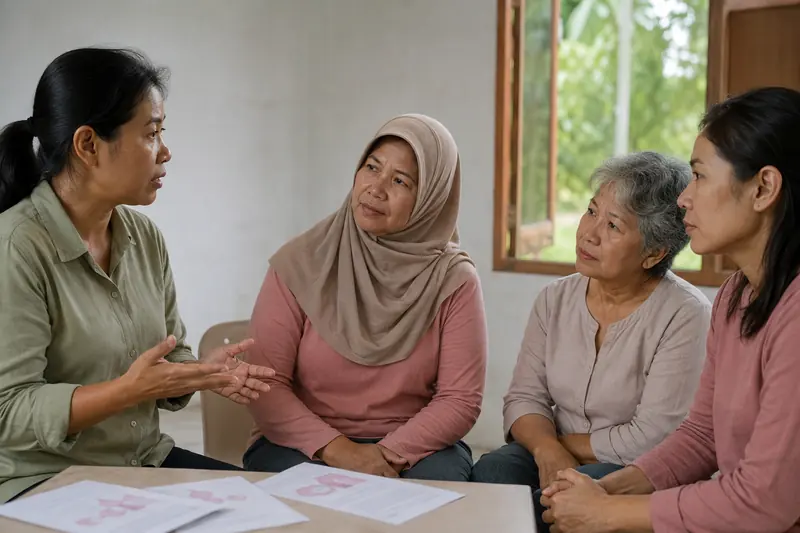
We train community health educators who deliver structured breast cancer awareness sessions in villages, community centres and places of worship. Women learn the warning signs, how to self-examine, and — critically — that help is available and they deserve it.
Learn more →Screening & Diagnosis
Mobile screening units bring free clinical breast examinations and ultrasound scans to women who have never been examined. We subsidise biopsy testing for women who present with a concern. Early-stage diagnosis transforms survival odds.
Learn more →Treatment Access
Being diagnosed is only the beginning. We fund transport to specialist hospitals, cover treatment costs for patients who cannot afford them, and support the community health workers who make follow-through possible.
Learn more →Active right now
Emergency Appeals
The Breast Cancer Crisis No One Is Talking About
In the world's poorest communities, breast cancer is caught too late — not because it cannot be treated, but because no one ever checks.
The Late-Stage Diagnosis Crisis
When breast cancer is caught at stage III or IV, survival chances are halved. In poverty-stricken regions, that is how most cases are found.
A composite story, representative of those we serve
"I found a lump three years ago. I did not go to the clinic for six months because I did not think it would be serious — and because I did not want to worry my family. By the time I went, the cancer had already spread. If the awareness session had come to my village a year earlier, everything would have been different."
Fatima, 41, Pakistan
Composite story representing the experiences of women in the communities we serve. No real patient data is used.
Donate so the next Fatima doesn't waitNHS & WHO sourced
The complete breast cancer guide
21 in-depth guides covering everything from symptoms and diagnosis to treatment, genetics and life after cancer — all sourced exclusively from the NHS and WHO.
Latest from our editors
Breast cancer resources
Breast Cancer in the US vs UK: Statistics, Survival and Key Differences
A woman diagnosed in London and a woman diagnosed in New York face the same disease — but very different systems. This data-driven comparison covers survival rates, screening ages, racial disparities, treatment access and the emerging treatments reshaping outcomes in both countries.
Dense Breasts After a Mammogram: What the New US and UK Rules Mean for You
Since September 2024, every woman in the US who has a mammogram is legally entitled to be told her breast density. In the UK, no such rule exists. Here is what dense breasts actually mean, why the US changed the law, and what women on both sides of the Atlantic should do next.
HRT and Breast Cancer Risk: The Evidence Without the Alarm
HRT headlines have caused decades of confusion. Here is a clear, NHS and NICE-aligned guide to what the actual evidence shows — which types of HRT carry a risk, how big that risk is in absolute terms, when the benefits outweigh it, and what this means for women who have had breast cancer.
Who we are
An initiative of World Aid Network
Breast Cancer Awareness is an initiative of World Aid Network — a London-based humanitarian organisation delivering targeted health and welfare programmes in underserved communities around the world.
World Aid Network was founded on the belief that where you are born should not determine your access to healthcare, education or dignity. Our breast cancer programme is one of several initiatives addressing the systemic health inequalities that cost lives in the world's poorest communities.
Every penny raised through this site goes towards our field programmes — community education, mobile screening and treatment access — in communities where breast cancer survival rates can be as low as 40%.
About Breast Cancer AwarenessEvery £1 you give saves lives
£10 funds a community awareness session. £25 gives a woman her first ever breast screening. £50 covers a biopsy test. Whatever you give, 100% reaches the women who need it most.
Donate NowSecure payment via Stripe. 100% to the field.