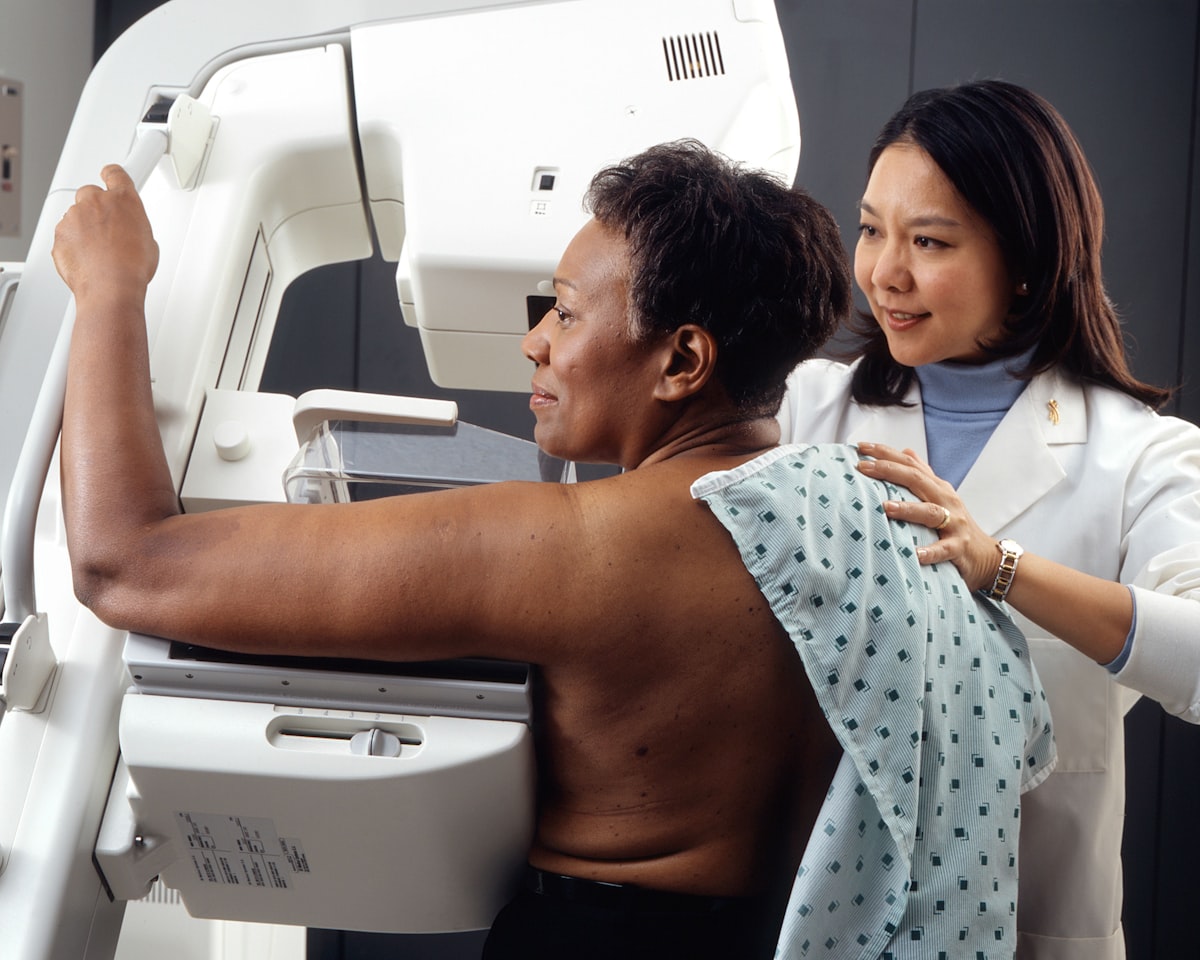
If you had a mammogram in the United States after September 10, 2024, you received something new in the post: a written statement about your breast density. This is the result of a federal FDA rule that came into force that month, requiring all mammography facilities to tell every patient whether she has dense breasts — and what that means. It is a significant change that affects roughly 40% of women screened. In the UK, no equivalent rule exists. Here is everything you need to know.
What are dense breasts?
Breasts are made up of fat, glandular tissue (milk-producing) and fibrous connective tissue. Breast density is a measure of how much of the breast is glandular and fibrous rather than fatty. You cannot feel it, and it has nothing to do with breast size or firmness. It is only visible on a mammogram X-ray — and this is precisely why it matters.
Why does breast density matter? Two compounding risks.
- The masking problem: On a mammogram X-ray, both dense tissue and tumours appear white — while fat appears dark. In dense breasts, a cancer can be hidden against the white background. Mammogram sensitivity can fall by 30–40% in extremely dense breasts. Cancers in dense tissue are significantly more likely to be 'interval cancers' — found due to symptoms between screening rounds, rather than at the screening itself.
- The independent risk: Dense breast tissue is not just harder to image — it also raises breast cancer risk by approximately 1.6 to 2 times, independent of the imaging challenge. This is thought to relate to the higher proportion of actively dividing glandular cells where DNA mutations can occur.
The US FDA rule: what changed in September 2024
On September 10, 2024, new US federal regulations came into force requiring every mammography facility in the country to include breast density information in the notification letters sent to patients after screening. Women are now told whether they fall into one of four BI-RADS density categories: A (almost entirely fatty), B (scattered density), C (heterogeneously dense) or D (extremely dense). Those in Categories C or D — roughly 40% of women screened — now receive explicit information about what this means and that they may wish to discuss supplemental imaging with their doctor.
Before this rule, many American women had dense breasts that went unacknowledged in their screening letters for years, despite radiologists being fully aware of the finding. The FDA rule closes that information gap.
What the UK does — and does not — do
The UK NHS has no equivalent mandatory density notification requirement. Radiologists read breast density into their mammogram interpretations — but patients are not routinely told their density category, nor are they informed that dense tissue may affect what the mammogram can and cannot see. Advocacy groups including Breast Cancer Now and dense breast awareness campaigners have been pressing NHS England for the same level of transparency that US women now receive by law. At the time of writing, no date has been set for a UK policy change.
What should you do if you have dense breasts?
- US women: if your post-mammogram letter says you have dense breasts, discuss it with your doctor. High density alone is not a diagnosis — but it is a conversation to have, especially if you have other risk factors such as family history or BRCA mutation.
- UK women: you can ask your GP or breast screening unit about your density — particularly if you have a family history or other risk factors. A direct question to your radiologist or GP is your best route.
- Everyone: continue attending routine mammograms. Even in dense tissue, mammography remains the best available screening tool. Do not skip it because of density concerns.
- Consider breast self-awareness. Regular self-checking (the NHS Touch–Look–Check method) is especially valuable if you have dense breasts, as mammography may be less sensitive.
- Ask about supplemental screening if you have dense breasts and additional risk factors. Options include ultrasound, contrast-enhanced mammography and MRI for high-risk women.
Supplemental screening options at a glance
- Ultrasound: widely available, can detect cancers invisible on mammogram in dense tissue. Higher false-positive rate than mammography.
- Contrast-enhanced mammography (CEM): uses contrast dye to highlight blood flow patterns that suggest cancer. Better sensitivity than standard mammography in dense tissue. Available at some NHS centres.
- MRI: the most sensitive tool, but expensive and reserved for high-risk women (BRCA carriers, strong family history) in the NHS. More accessible privately in the US.
- Tomosynthesis (3D mammography): creates layered X-ray slices that reduce the masking effect of overlapping tissue. Increasingly available on both sides of the Atlantic.
Dense tissue is everywhere — mammograms are not
Dense breast tissue affects women in every country equally — it is a biological characteristic, not a product of where you live. The chance of it masking a cancer is the same no matter where you are. What is not equal is what happens next. In the UK, a woman receives an NHS mammogram every 3 years from age 50. In the US, she now receives a written density notification and can discuss supplemental imaging. In low-income countries, she is almost certainly never offered a mammogram at all. No letter arrives. No conversation happens. The cancer, when it is eventually found — if it is found — is almost always at Stage III or Stage IV.
Breast Cancer Awareness — an initiative of World Aid Network — funds mobile screening units that take clinical breast examination and ultrasound directly to communities where no mammogram has ever been available. Women who would otherwise wait until symptoms became too severe to ignore are examined, referred and given the chance at an early-stage diagnosis. A donation of £25 funds one of those screenings. For a woman in an underserved community, it may be the first breast examination she has ever had. It may also be the one that saves her life.